
Presentation by SCHMETZ Needles on October 15, 2025

Rhonda Pierce, educator from SCHMETZ Needles joined us for a Meetup on Zoom. Rhonda shared a lot of very helpful info on sewing machine needles.
Here are the highlights!
- Home sewing needles have a bevelled edge and flat shank so they can be perfectly positioned in our machines.
- What does the number on a needle pack mean? (70/10, for example)
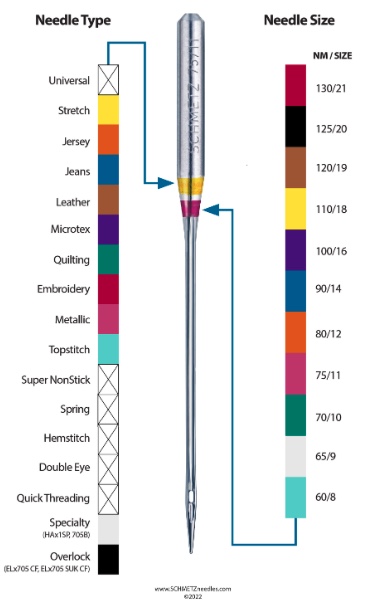
- The first number is the Metric size, the second is the corresponding US size
- It’s the metric measurement of the shank
- A 70/10 needle has a shank circumference of .7MM (.7 x 10 = size)
- Bigger number equals wider needle
- The first number is the Metric size, the second is the corresponding US size
- The groove on the front of the needle cradles thread so it moves evenly and smoothly
- The scarf on the back is where the bobbin thread catches
- There are different sizes of needle eyes:
- Universal needles have an eye that is 40% of the width of the needle blade
- Embroidery needles have a wider eye
- Topstitch and Metallic needles have an elongated eye
- A larger eye puts less stress on the thread. It’s all a way to prevent your thread from breaking when you sew!
- Schmetz has 2 bands of colour on a needle. If your Schmetz needle has only ONE band of colour, it was manufactured before 2014!
- Our member Julie asked if old, unopened needles were still good. Rhonda replied that they are! Just test the needle before starting on your project.
- Here’s a link to the Schmetz Colour Chart so you can identify your needle
- What else is on the needle case? There’s usually a number like 130/705. These are the NEEDLE SYSTEMS. What do these letters and numbers mean?
- 130/705 means that it’s for a home sewing machine because it has a flat shank. (Industrial machines may not need a flat shank.)
- Schmetz is a German company, and some of the abbreviations used correspond to the German spelling of the word. Sehr gut!
- H = Scarf
- ELX 705 = means its designed for a serger/overlocker. (Check your machine to see if it needs a specific serger needle such as ELX)
- SUK = medium ball point (often used on cover stitch machines)
- E = Embroidery
- J = Jeans
- Q = Quilting, and many more
- The Universal needle is the most popular needle. It has a slightly rounded tip and works on most types of fabric. 80/12 is the most popular size, followed by 90/14. Universal needles also come in Twin and Triple needles
- Microtex Needles – slim with an acute point. Microtex create the most precise stitches. They dull quickly and need to be replaced more frequently.
- Did you know? A Microtex needle works well with Batik and other tightly woven fabrics
- Jersey or Ballpoint Needles – have a medium ballpoint and are good for many knits
- Stretch needles – also have a medium ballpoint but a smaller eye and deeper scarf
- The scarf impacts how well a bobbin thread catches so if you have skipped stitches, you may want to switch to a needle with a different scarf
- If a fabric has lycra, spandex, or elastic, try a Stretch needle
- Super Non-Stick – a new needle that was introduced in 2020
- It’s Gunmetal colour and has an anti-adhesive coating (Rhonda couldn’t say Teflon™️, but we can 😉)
- It also has an optimised blade for a cleaner stitch, and enlarged eye (less stress on thread)
- Great for: Anything with a stabilizer because it won’t get gummed up – so embroidery and applique. Also splash fabric, coated fabric, vinyl, velcro, food safe fabric, metallic thread, landscape quilting
- Available in 4 sizes
- Nicole asked what to use for mixed fabric – bags or purses
- Rhonda suggested a Super Non-Stick, size 100
- Nicole asked what to use for mixed fabric – bags or purses
- Embroidery Needles have a widened eye so thread doesn’t shred
- Available with a chrome or titanium coating which gives the needle extra strength and a bit longer stitching time
📖 RELATED: Everything You Need To Know About Sewing Machine Needles by The Sewing Machine Man on Substack
When should you change your needle? How long should a needle last?
- Could be 3 seconds if you hit a pin or 20 hours if not sewing aggressively and using a fine fabric that is not abrasive
- What are the clues that it’s time to change your needle?
- Thread is breaking and shredding
- Thread has worn a groove into the needle
- Fabric is puckering or snagging
- Stitches are skipping
- Seams are uneven or stitches are wobbly
- Needle is clicking, popping, or clunking
- Do you have a burr or snag on the needle? Run your needle across a piece of scrap jersey fabric or old pair of pantyhose (we know you probably have a pair or two in the back of a drawer). If it snags, discard it
- The needle is the least expensive tool in your sewing toolbox. Change it as needed.
Specific Suggestions:
- Vinyl – experiment with super nonstick universal needle. Start with 80/12 size.
- Stretch Thread – use Stretch 90/14 or Super Nonstick starting with 80/12 or 70/10
- Experiment with different needle sizes for different types of thread:
- Heavier weight thread try 90/14 or larger
- Finer weight thread – try 70/10
- Micro thread – even smaller (60/8)
- Tightly woven sheer poly fabric – Microtex
- Decorative stitching on the above – Black Super Fine Needle (only available in size 70/10)
- Pleather or Vinyl – Non-Stick Needles or maybe Microtex
- Thick Vinyl – try Leather Needles
If you’d like more help:
Sign-up for the Schmetz Newsletter – Rhonda gave us a hint that there are special offers through the newsletter: Newsletter Sign-Up
🔗: Rhonda’s Personal Website: https://www.SewMoreStitches.com
 Calgary Sews